
5 Money Guilt Traps for Women
Why You Can Let Them Go
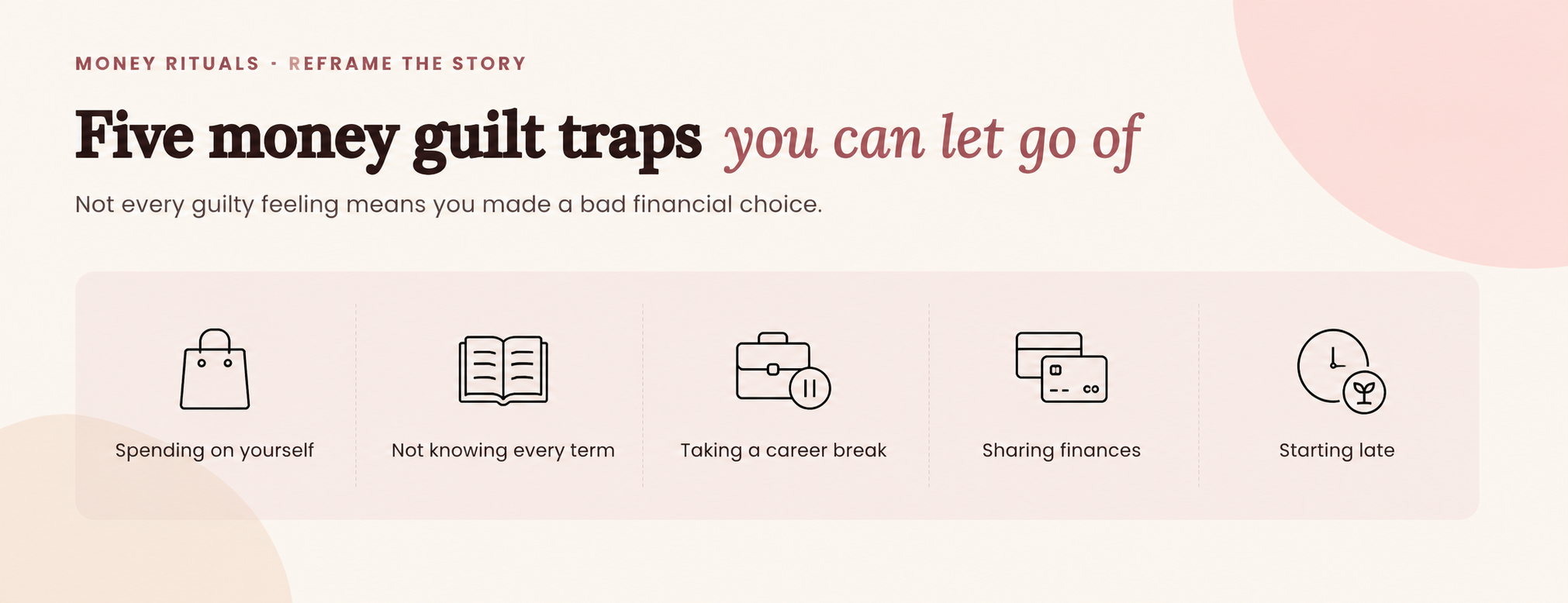
Money guilt traps for women can appear in surprisingly ordinary moments—spending on yourself, taking a career break, relying on a partner or feeling as though you started investing too late. But not every guilty feeling points to a bad financial decision.
There is a very particular kind of financial stress that comes not from anything you have done wrong, but from repeatedly being told, subtly, by family, culture, and occasionally a well-meaning Instagram Reel — that the way you handle money is suspect. That you are too indulgent, not careful enough, too late, too slow, too dependent, or not independent enough.
It is exhausting. It is also, largely, unfair.
So let us talk about the five things women are told to feel bad about financially — and why, with a little context, most of them simply do not deserve the weight they are given.
5 Common Money Guilt Traps for Women
You buy a nice kurta, book a solo weekend trip, or treat yourself to a skincare product and immediately the mental calculation begins. Should I have spent that? What will they think? Women in Indian households even those with their own salaries often feel they need to justify personal spending in a way their husbands, brothers, or fathers simply do not.
This is not a personal failing. It is cultural conditioning which has a real cost: when you feel guilty about every rupee spent on yourself, you either quietly deprive yourself or you spend anxiously, which makes neither feel good.
If it is within your budget and it matters to you, you do not owe anyone a justification.
XIRR. Expense ratio. Alpha. Beta. Exit load. STP. If you have ever sat in a conversation about money and nodded while understanding very little, you know the particular shame of feeling financially illiterate around people who seem to know these things fluently.
Here is what nobody tells you: you do not need to know every financial term before you begin. Understanding the concepts relevant to your own decisions—and looking up the rest when needed—is completely normal. The fact that you were not taught this growing up is not your fault; it is a gap in how financial education has traditionally never been taught in school enough.
Start where you are — one concept at a time is enough.
Whether it was for a child, an ageing parent, your own health, a marriage that required relocating, or simply because you needed to stop, career breaks carry a weight that follows women long after they return. The financial version of this guilt is particularly sharp: years of compounding you missed, the SIP you could not keep running, the salary increments that did not happen.
This framing, while mathematically accurate in isolation, ignores the reality of what you were actually doing during those years. Care work has economic value, it is just never counted.
A break is not a permanent setback unless you treat it as one. Women who return to investing at 40 still build meaningful wealth.
Financial independence has become something of a rallying cry and rightly so. But somewhere along the way, the message got garbled into this: if you share finances with your spouse or depend on a partner’s income at any point, you are somehow doing it wrong.
A joint account does not mean you are financially dependent. Many couples manage shared goals this way without either person losing autonomy. Similarly, if one partner earns more or one person steps back for a season, that is a shared decision — not a power imbalance unless it is being used as one. What matters is that you know where the money is, your name is on the key accounts, and you have access to your own funds. That is the actual baseline.
Structure your finances in a way that works for your life, not for someone else’s definition of independence.
Perhaps no piece of financial guilt lands harder than this one for women in their 30s and 40s: the sense that the train left without them. They did not start a SIP at 22. They did not open a PPF the year they began working. They do not have twenty years of compounding ahead of them. And so — the reasoning goes — the damage is done.
It is not. A woman who begins investing at 40 with a 15-year horizon still has fifteen years of compounding. That is not nothing. That is retirement money, a child’s education fund, or genuine financial security. The finance world has an unfortunate tendency to frame every “late start” as a catastrophe, when the actual catastrophe is not starting at all because you decided it was too late.
The best time to start was earlier. The second best time is today.
Why Women Experience Money Guilt
Most financial guilt aimed at women comes from one of two places: cultural scripts about how women should relate to money (quietly, gratefully, and not too ambitiously), or financial content that was written for a version of a woman’s life that does not account for care responsibilities, career pauses, or the reality of shared financial lives.
Both of them have an interest in making you feel like you are always slightly behind, slightly wrong, slightly not enough. And when you feel that way, you either disengage from money entirely which is genuinely costly, or you make decisions from anxiety rather than clarity.
How to Overcome Money Guilt
Guilt is a feeling, not a plan. If any of the five items above hit close to home, the most useful thing you can do is to consciously identify them. It is to take one small, concrete action that moves the needle forward.
Let Go of Guilt—Not Financial Awareness
You are allowed to have a complicated financial life. Most women do. That complexity is not a failure, rather it is just real life. And real life can be planned for, even if it cannot be made neat.
The goal is not a perfect money story. The goal is your money, working for your life, on your terms.
Ready to find out where you actually stand?
Two minutes, zero judgment. Find your Money Era and get your personalised next moves.