
Your ₹300 Matcha Is Not
The Problem
Someone around you is about to do that math again. Oh, you’re spending ₹300 on fancy matcha and coffee – do you know you’d become a millionaire if you saved this money? Girl, let’s talk about what’s actually draining your account instead.
Someone, somewhere, is going to look at your iced matcha and do the math out loud. “Do you know how much your fancy beverage indulgence could become in a SIP?” But is it all that takes to be financially responsible?
Nod. Smile. Then completely ignore them, because I need to tell you something they will not. That ₹300 matcha is not why your account feels perpetually one notification away from disaster. It never was. And every time you feel guilty about it instead of checking the actual problem, you’re falling for the easiest, laziest piece of money advice on the internet.
Where this whole “cut your latte” thing even came from
This idea, that your small daily treats are secretly ruining your finances, has an actual name. It’s called the latte factor, a theory some finance author came up with in the 90s, way before your matcha era, arguing that a few dollars a day on coffee adds up to a fortune over time.
The math isn’t technically wrong. ₹300 a day invested instead really does become a big number over 20 to 25 years. But this advice has survived so long for one reason only, it is easy to say. It is a clean, guilt tripping image, you, holding an iced drink, being irresponsible, and it is way simpler to sell than the actual boring stuff like insurance and debt and where your money is sitting doing nothing.
The latte factor puts all the blame on your ₹300 joy and conveniently lets the big money problem sitting somewhere else in your life off the hook completely.
The real money leaks nobody warns you about
Here’s what’s actually expensive. Quiet, unglamorous, and a lot bigger than your matcha habit.
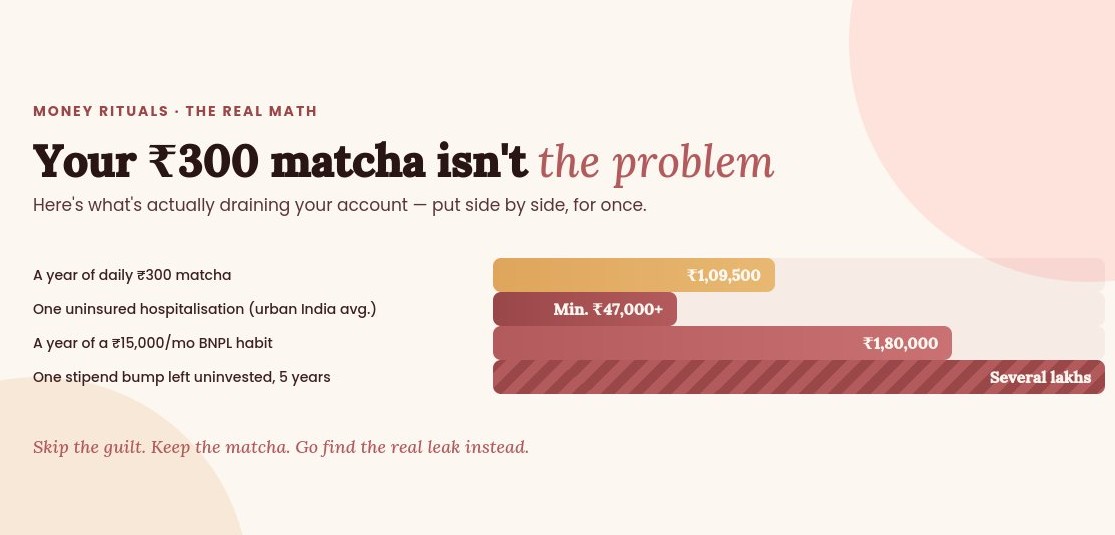
Simpl, LazyPay, that “pay in 4” checkout button that appears out of nowhere at 1am. Individually, each purchase felt harmless. Together, they quietly become a running tab that never actually clears because a new one shows up before the old one is paid off. Open the app right now and note what’s that costing you each month in total.
Most regular savings accounts in India pay somewhere around 2.5% to 3.5% interest a year, according to this breakdown of current rates. Inflation usually runs higher than that. So money just sitting there isn’t neutral, it’s losing value in real terms while feeling completely safe. That “emergency fund” doing nothing in a basic savings account is a slower, quieter leak than any matcha could ever be.
This is the one that should actually stress you out. A recent government health survey found the average hospitalization now costs close to ₹47,000 in urban India, and that’s just the average. If your only cover is a family floater you don’t control, one hospital visit can undo years of matcha restraint in a single bill. Also, health insurance gets more expensive the older you get, so getting your own policy now, while you’re young and premiums are cheap, is genuinely one of the smartest things you can do this year.
Income goes up, spending follows, completely normal. The leak isn’t treating yourself, it’s that investing almost never gets the same bump. If your SIP has been sitting at the same ₹500 since your first earning, that gap between what you earn now and what you’re actually putting away is money quietly disappearing every month.
Ask most people who seem financially put together what their net worth is, not their salary, their actual net worth, and you’ll get silence. That silence is the real problem. Matcha guilt is just an easy thing to feel bad about instead of the number you’ve never actually checked.
Put it side by side and the matcha doesn’t even place
What to actually do this week
Not fifty changes. Five, and they’re the ones that move the number.
Open every BNPL/EMI and credit app you have and add up what you owe. Not to spiral, just to see it.
Move your emergency fund out of a basic savings account into a liquid fund or high yield account. Takes fifteen minutes, costs you nothing.
Get health insurance in your own name while you’re young enough for it to be cheap.
Bump your SIP by the same percentage of your next increment or hike in salary.
Calculate your net worth once. Everything you own minus everything you owe. Just once.
The actual point
You’re allowed to enjoy the matcha. You’re allowed to enjoy your life right now, no financial asterisk required. The guilt around small joys was never really about coffee, it was a distraction dressed up as discipline.
Skip the guilt. Keep the matcha. Go find the real leak instead.
Curious where you actually stand? Take the Money Era quiz, two minutes, zero judgment.