
Stocks, Bonds, Gold and Real Estate:
What Does Each Investment Actually Do?
Everyone tells you to diversify. Almost no one tells you what each asset is actually doing for your money.
Ask four people where you should invest and you’ll get four different answers. Stocks create wealth, property is the only “real” asset, gold never lets you down, or stay safe with bonds. Possibly all of them are right, but only partly.
The useful question isn’t “Which investment is best?” It’s “What do I need my money to do?” That’s really what stocks vs bonds vs gold vs real estate comes down to.
| Asset class | Main job | Common risk | Suited to |
|---|---|---|---|
| Stocks | Long-term growth | Volatility, business failure | Long-term goals |
| Bonds | Income & stability | Credit & interest-rate risk | Near-term goals |
| Gold | Diversification | No cash flow, price cycles | Portfolio protection |
| Real Estate | Utility & income | Low liquidity, concentration | Long-term use or rent |
Stocks: the growth engine
A stock is a small ownership stake in a company. If it grows profits, the share price may rise. Over long periods, equity has historically outpaced other asset classes, because you’re participating in businesses that grow over time.
The trade-off is volatility. A stock up 15% this year can be down 10% the next, that’s why stocks are wrong for money you’ll need soon.
Bonds: the stabiliser
A bond is a loan, you lend money to a government or company, and get fixed interest back on a schedule. Per SEBI’s investor education material, “fixed income” doesn’t mean risk-free, bonds carry interest-rate risk and the chance an issuer doesn’t repay.
Indian retail investors can access government securities via RBI Retail Direct, corporate bonds, or debt mutual funds, each with different risk, tax, and liquidity.
Gold: the diversifier
Gold doesn’t generate cash flow, your return depends on selling it higher than you paid. Per the World Gold Council’s research, it may hold up during market stress or currency weakness, but doesn’t rise every time stocks fall.
Jewelry carries making charges and resale deductions. For investment purposes, gold ETFs or mutual funds are usually the more transparent route.
Real estate: utility first
A home you live in and a property bought to earn a return are different decisions. Your home provides utility and stability. An investment property needs to be judged on rent, vacancy, costs, and resale value.
Property prices don’t rise equally everywhere, and direct real estate is capital-heavy and slow to sell. REITs offer property exposure without buying an entire property.
Stocks, bonds, gold, and real estate aren’t four contestants fighting for first place. They’re four tools.
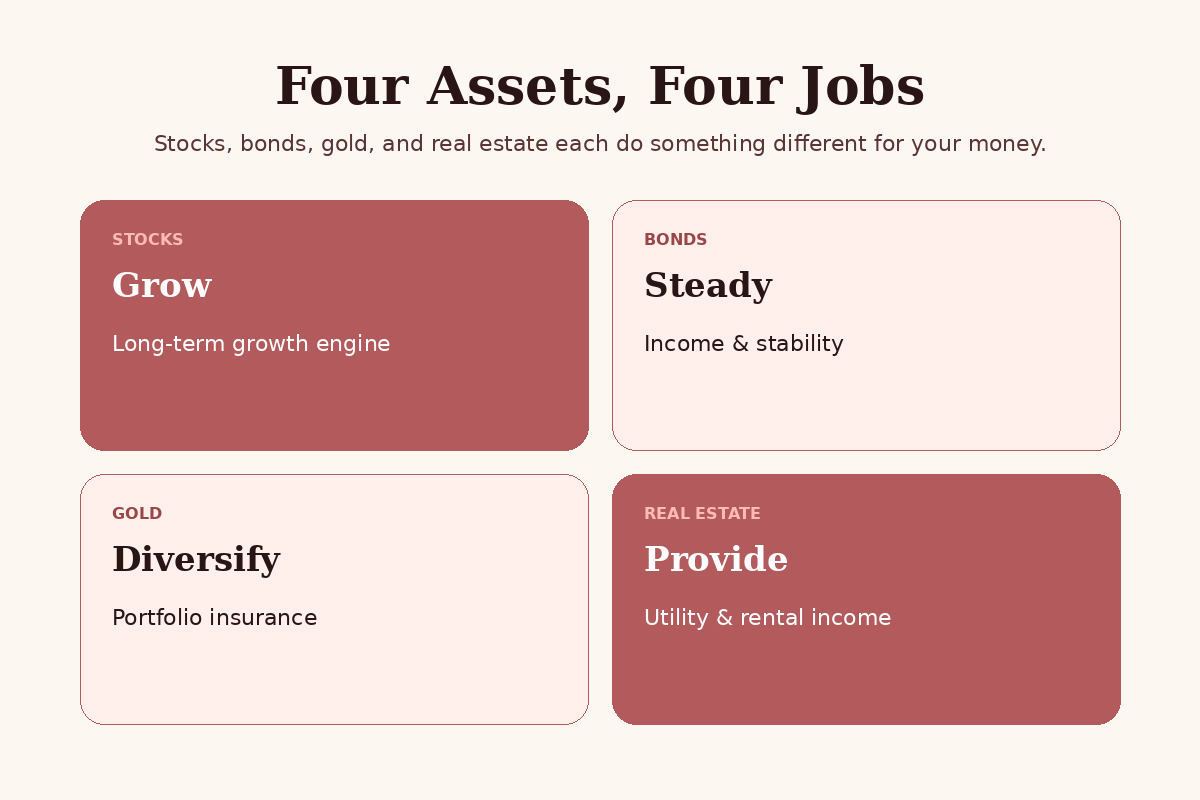
Four assets, four different jobs — pick based on what you actually need.
Are stocks better than gold for long-term investment?
Are bonds safer than stocks?
Is buying a home the same as investing in real estate?
Can I invest in all four asset classes?
How much gold or real estate should be in my portfolio?
Which investment is the most liquid?
This article is for education only and isn’t investment, tax, or legal advice. Consult a SEBI-registered investment adviser for personalised guidance.