
Woodhull and Claflin: The Sisters Who Made Room for Women on Wall Street
In 1870, two sisters opened a brokerage firm in the financial capital of the world. Women could not vote. The press called them “Petticoats Among the Bovine and Ursine Animals.” They opened anyway.
Victoria Woodhull was born the seventh of ten children to a con man and an illiterate mother in rural Ohio. She had three years of formal schooling. By 14 she was married to an alcoholic doctor. By her mid-twenties she was divorced, supporting two children on her own, and working as a traveling healer.
Her younger sister Tennessee Claflin, called Tennie, grew up in the same household. Neither of them was supposed to end up anywhere near a trading floor.
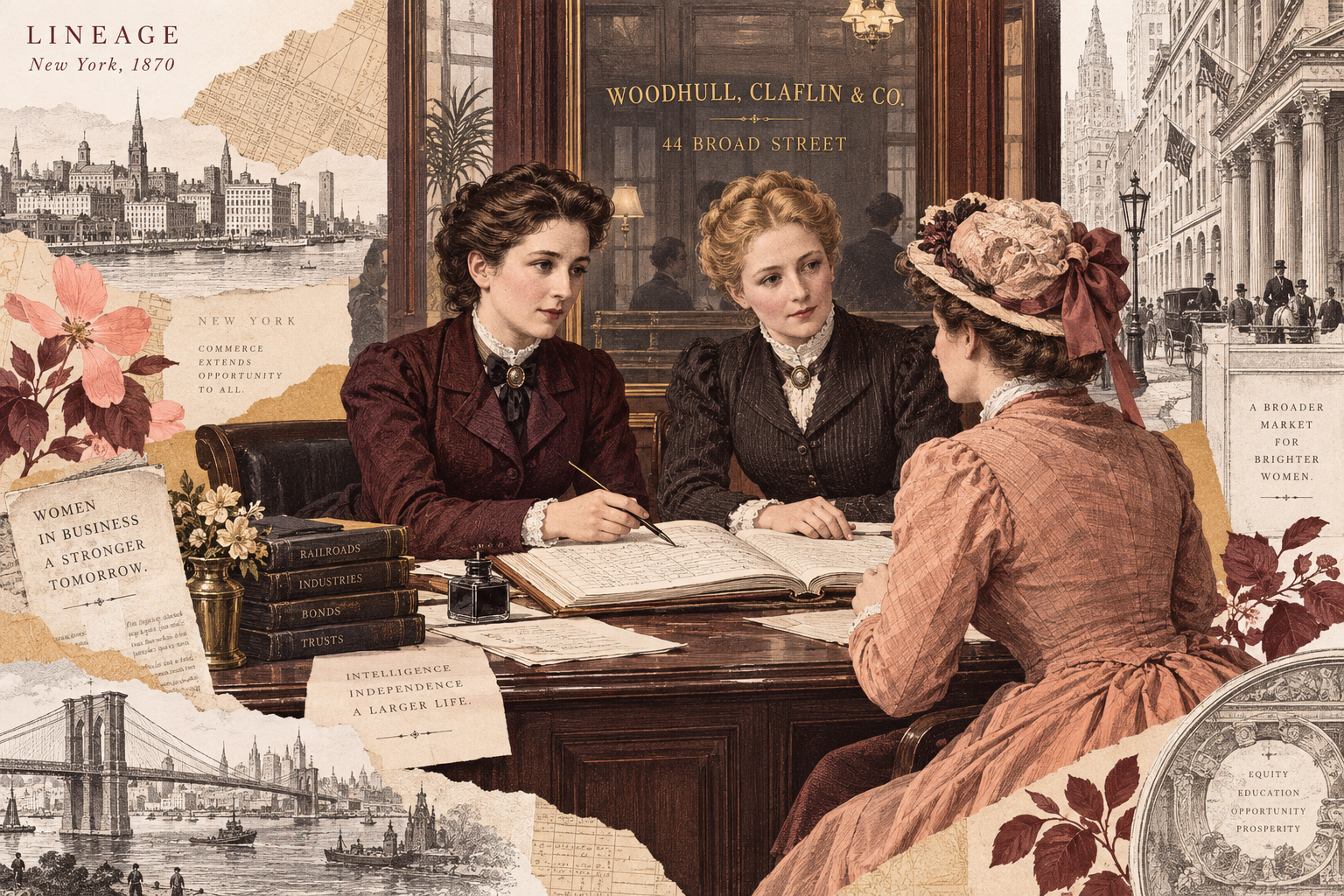
In January 1870, the two of them opened Woodhull, Claflin and Company at 44 Broad Street in New York City. It was the first brokerage firm on Wall Street operated by women. Victoria was 31. Tennie was 24. The reaction was about what you would expect.
What actually happened
- 1868 Victoria and Tennie arrive in New York and are introduced to Cornelius Vanderbilt, the wealthiest man in America. He is reportedly drawn to Tennie’s company and to Victoria’s work as a spiritual medium. He becomes their financial backer.
- January 1870 Woodhull, Claflin and Company opens at 44 Broad Street. The New York Sun runs the headline: “Petticoats Among the Bovine and Ursine Animals.” The New York Herald calls them “the Queens of Finance” and “the Bewitching Brokers.” Both headlines tell you more about the press than about the sisters.
- May 1870 Using profits from the brokerage, they launch Woodhull and Claflin’s Weekly, a newspaper that at its peak reaches a national circulation of 20,000. It covers women’s suffrage, labor reform, and financial topics.
- December 1870 Victoria becomes the first woman to testify before a Congressional committee, arguing that the 14th and 15th Amendments already granted women the right to vote. Susan B. Anthony and Elizabeth Cady Stanton postpone their own convention to attend her testimony.
- May 1872 Victoria is nominated as the first woman candidate for President of the United States by the Equal Rights Party. Frederick Douglass is named as her running mate (without his knowledge). She is 33 years old.
- November 1872 Days before the election, Victoria, Tennie, and Victoria’s husband Colonel Blood are arrested for publishing an “obscene newspaper” after exposing a prominent clergyman’s affair. They spend the next month in jail. The arrest prevents Victoria from casting a vote for herself.
What the brokerage actually was
Woodhull, Claflin and Company was not a hobby or a stunt. Vanderbilt’s backing gave them credibility and capital, and Victoria had a genuine instinct for reading markets. On one documented occasion she advised Vanderbilt to sell short at 150 cents per stock. He followed the advice and reportedly made millions on the trade.
The firm offered investment services to clients and generated enough profit in its first year to fund the newspaper, a presidential campaign, and the sisters’ increasingly public political activities. It operated on Wall Street at a time when women could not hold a seat on the New York Stock Exchange, could not serve on a corporate board, and could not vote. They were not guest visitors in that world. They were participants with a revenue-generating business and a client list.
The press treated them as a spectacle. Many contemporary men’s magazines published sexualized illustrations of the pair running their firm, connecting the idea of financially independent women with promiscuity and scandal. The pattern is familiar: a woman in a financial role is automatically suspicious. The coverage of their firm was less about their trading record and more about their appearance, their love lives, and whether they had any right to be there at all.
The part that matters more than the brokerage
Victoria Woodhull understood something that most financial history overlooks. In an 1896 article on women’s suffrage, she wrote: “Suffrage is only one phase of the larger question of women’s emancipation. More important is the question of her social and economic position. Her financial independence underlies all the rest.”
She said this in 1896. The argument that financial independence is the foundation, not the result, of women’s equality is one that most modern personal finance content still has not caught up with.
And in a February 1900 interview with Woman’s Home Companion, she described the structural barrier directly: “A woman hasn’t as many chances for making money as men have. She isn’t around or among men, as a rule, and she doesn’t hear of the opportunities for investment which are talked of day by day, in Wall Street and other financial centres.”
That was not a complaint. It was a diagnosis. Women were not failing to invest because they lacked interest or ability. They were failing to invest because they were excluded from the rooms where financial information circulated. The brokerage was her attempt to build a different room.
Woodhull diagnosed it in 1900: women do not hear about investment opportunities “talked of day by day, in Wall Street.” In 2026, the version of that problem is quieter but not gone. The office conversation about stock options that happens between men at lunch. The family investment decisions made by a father who does not explain his reasoning to his daughters. The assumption that a woman asking about asset allocation is a beginner, when a man asking the same question is just doing due diligence.
You do not need to wait for someone to include you in the room. You can build your own. The tools exist now in a way they did not for the Claflin sisters. A demat account, a mutual fund app, a SIP set to autopay. None of these require anyone’s permission or sponsorship.
This week’s move: if there is a financial decision in your household that you are aware of but not involved in, ask to see the numbers. Not to take over. Not to question the decision. Just to know what is there. Woodhull opened a brokerage to get access to information. You can start by asking for access to the family’s mutual fund statement.
Primary source: Victoria Woodhull, Wikipedia (extensively referenced article with 90+ citations). Additional references: Mary Gabriel, Notorious Victoria: The Life of Victoria Woodhull Uncensored (1998); Barbara Goldsmith, Other Powers (1998); Myra MacPherson, The Scarlet Sisters (2014); Amanda Frisken, Victoria Woodhull’s Sexual Revolution (2004). The 1900 Woman’s Home Companion interview is cited in the Wikipedia article via Gerald W. Johnson, “Dynamic Victoria Woodhull,” American Heritage, June 1956. The “Petticoats” headline is attributed to the New York Sun and cited across multiple biographies.
One note on attribution: many of Woodhull’s published speeches and articles were collaborative works. Her newspaper columns were frequently written with or by her husband Colonel Blood and associate Stephen Pearl Andrews. The quotes used above are attributed to Woodhull by the cited sources, but the question of sole authorship applies to much of her published output.
Next in Lineage: Maggie Lena Walker, the first Black woman to charter a bank in the United States. She built it to serve a community that banks refused.
Lineage 01: Hetty Green · Kinda Chic to Care About Financial Independence · Find Your Money Personality