
Nobody Taught Us How to File Taxes So Let’s Do It Together, Beginning to End
If you have ever forwarded a tax message to someone else with a “can you just handle this” — this one is for you. We are going to file your return together, calmly, in simple language with no complicated jargons to confuse you.
Let us start with something honest. Somewhere out there is a woman who negotiated her salary, runs a home budget in her head down to the last rupee, and remembers every EMI date without a reminder — and yet, when the words “income tax return” appear, something in her says not me, someone else can do this one.
If that woman is you, take a breath. It is not that you cannot do it. It is that nobody ever sat you down and explained it in a language that felt like yours. School skipped it. Most of us learned about compound interest before we learned what a Form 16 was. So the fear was never really about tax — it was about being handed something with no instructions and being expected to already know.
First — Is This Even About Me?
Fair question, and one a lot of women quietly wonder without asking. So let us clear it up plainly, because the answer is often “yes, and it works in your favour.”
Your office already cut tax from your pay every month — that is TDS. Filing is how you tell the government, “here is the full picture” — and very often, how you get some of that money back. Yes, back. In your account.
Think you are off the hook because there is no salary slip? Not quite. If you earn interest on fixed deposits or savings — money in your name — that counts as income too. Filing can mean claiming back tax the bank already deducted. That FD your father or husband opened “in your name for tax” has your name on it for a reason. This is you, using it.
No Form 16 because no single employer? Completely normal. Your income from clients, your little business, your Instagram store — it all counts, and there is a form built exactly for you. No boss handing you papers means you are the boss of these papers now.
And here is a reason to file even if your income is below the taxable limit: a filed return is one of the cleanest proofs of income you can own. Applying for a visa, a home loan, a credit card in your own name? They ask for it. It is a quiet little document that says I exist, financially, on my own terms.
The Whole Thing Is Just A, B, C
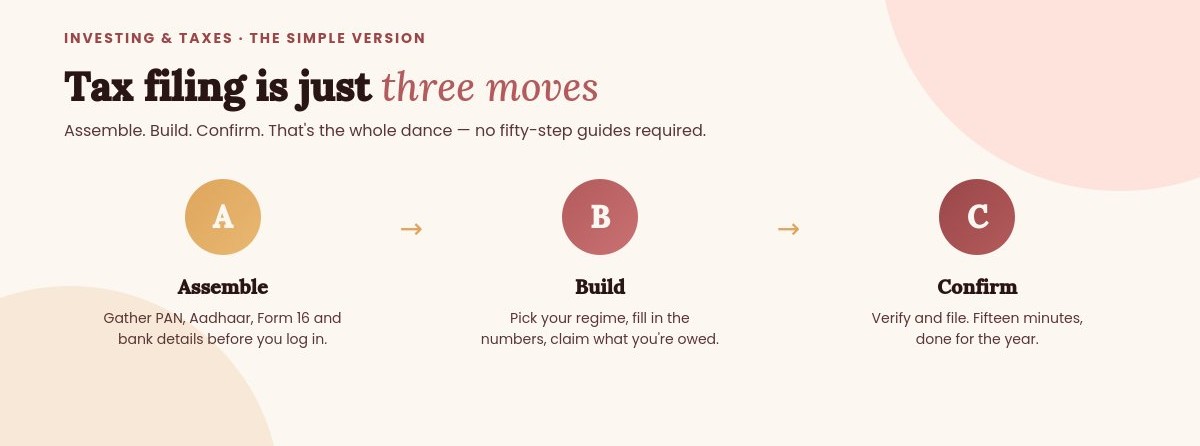
Ignore the fifty-step guides that make this look like heart surgery. Strip it all away and tax filing is three moves. Assemble. Build. Confirm. That is the whole dance.
Assemble everything first
Gather your papers before you log in — the way you would lay out all your ingredients before cooking, so you are not running to the shop mid-recipe. It turns a dreaded afternoon into a fifteen-minute job.
- PAN and Aadhaar — and check they are linked. One thing to catch: if your PAN is in your maiden name and your bank in your married name (or the reverse), sort that mismatch first — it is the single most common thing that trips women up, and it is fixable.
- Form 16 — if you are salaried, your office gives you this. It is just a summary of your pay and the tax already taken.
- Bank details — so your refund lands in the right account. Ideally, an account in your own name.
- Interest certificates — from savings accounts and FDs. Yes, even the “small” ones.
- Investment proofs — for anything you want to claim to lower your tax (we will get to which ones).
- Form 26AS and AIS — the government’s own record of your income. Download both from the e-filing portal and treat them as your answer key.
Build it on the portal
Log in to the official e-filing website, pick your form, and let the pre-filled details carry most of the load. This is the part you have been dreading — and the part that is honestly almost done for you.
Here is the relief nobody mentions: the income tax e-filing portal already knows most of your numbers. Your salary, the tax deducted, the interest earned — it fills them in. Your actual job is to check that they match your papers, add anything missing, and claim what is yours. You are not writing an exam. You are proofreading a form someone half-filled for you.
Most salaried individuals use ITR-1, the simplest form there is. If you freelance, run a business, or sold shares or property this year, you may need a different one — and the portal points you there. And if at any moment it feels genuinely tangled, paying a tax professional a small fee is not “failing to do it yourself.” It is being smart with your time. Knowing when to ask for help is the skill.
Confirm — and actually verify
Hitting submit is not the finish line, and this is where more people fall than anywhere else. If you do not verify, in the eyes of the system, you never filed at all.
After you submit, you must e-verify — a thirty-second job with an Aadhaar OTP. This is the “I’ll finish it later” trap: the return sits there, unverified, and quietly does not count. So do it in the same breath as submitting, while you are still logged in and still have the momentum. Submitted and verified. Two ticks, not one.
The Big Fork: Old Regime or New?
You will hit a screen asking you to choose between two tax “regimes,” and this is usually where the confidence wobbles. So, plainly: the old regime lets you shrink your taxable income using deductions — your investments, insurance, rent, and so on. The new regime gives you lower rates but strips away most of those deductions.
There is no answer that is right for everyone — it depends entirely on your own life. If you invest in tax-saving instruments, pay rent, hold health insurance, the old regime might save you more. If your money life is simpler, the new one often wins. The grown-up move is to run your numbers both ways before choosing. Five honest minutes here can be worth thousands.
And here is something most people do not realise: the regime you picked when your office asked you to “declare” at the start of the year is not final. That was only for how much tax they deducted month to month. At the time of filing, you are free to switch — if you declared old but the new works out better for you, file as new, and vice versa. (One caveat: those with business or professional income have tighter rules on switching, so check your case.) The portal recalculates everything. Nobody is holding you to a choice you made in a rush last April.
Not sure which regime saves you more? You do not have to do the maths by hand. Free income tax calculators — on the official portal, and on platforms like ClearTax, Groww and Tax2win — let you punch in your numbers and instantly see both regimes side by side. Many of these platforms also let you file your entire return through them, with a guided, question-by-question flow that can feel gentler than the government portal for a first-timer. The portal is always free; the others often have a free tier plus paid help if your return is more involved.
Which Form Is Yours? A Quick Map
The portal usually points you to the right form, but it helps to walk in already knowing which one is likely yours. Here is the plain-language map:
| Form | Who it’s for | File this if… |
|---|---|---|
| ITR-1 (Sahaj) |
Salaried individuals, pensioners | You earn from salary/pension, one house property, and interest income — and total income is within the limit for this form. The most common first-timer form. |
| ITR-2 | Salaried with more going on | You have capital gains (sold shares, mutual funds or property), more than one house, or foreign income — but no business income. |
| ITR-3 | Business owners & professionals | You run a business or earn as a professional (consultant, doctor, freelancer treated as a profession) and maintain books of accounts. |
| ITR-4 (Sugam) |
Small business & freelancers (presumptive) | You freelance, tutor, or run a small business and opt for the simpler “presumptive” scheme where income is estimated as a set percentage of turnover. |
The Deductions Worth Knowing By Name
A “deduction” sounds technical but means something lovely: an amount the government lets you subtract before it calculates your tax. Less taxable income, smaller tax bill. If you are on the old regime, meet the ones worth knowing:
- Section 80C — your PPF, ELSS, life insurance, EPF. Up to ₹1.5 lakh a year. The workhorse of tax saving.
- Section 80D — health insurance premiums, for you and the family you cover.
- Section 80TTA — the interest your savings account earns, up to a small limit.
- HRA — if you pay rent and it is built into your salary, this one is often underused by women who simply did not know to claim it.
Three Things We Tell Ourselves — And Why They’re Wrong
And If the Date Slips Past You?
Breathe — not a catastrophe, just a pricier version of the same task. File late and you may owe a small penalty plus interest, and lose the right to carry some losses forward. You can still file a belated return for a while after. But on time is always the calmer, cheaper choice — and you now genuinely can.
This article is for general information and education only, and is not tax or legal advice. Tax rules, deduction limits, forms and due dates change from year to year and vary with individual circumstances — always confirm the current details on the official income tax e-filing portal, or speak with a qualified tax professional, before you file.